A manager of an online store desires that customers repurchase from the store.In several studies, it has been found that there is a high tendency (intention) to repurchase (repurchase intention), but not intensely. This means there is a gap between repurchase intention and actual repurchase. A company’s marketing programs can fill and minimize this gap by doing electronic-Relationship Marketing (e-RM). Customers are more likely to make repeat purchases as long as they are satisfied. This study analyzes and identifies factors that drive the change from only repurchase intention to repurchase. The study was conducted by surveying 262 customers of the top 5 online stores in Indonesia and analyzing the data using PLS-SEM (Partial Least Square-Structural Equation Model) to determine whether e-RM has a moderating effect on repurchases.The sample was selected based on the purposive sampling method and respondents were surveyed with a 5-point Likert scale.Results suggest that e-RM does not moderate the repurchase intentions. On the other hand, the E-RM effect on repurchase is significant.
E-Relationship Marketing (e-RM) uses customer data to gather feedback based on relationships with customers.Using this marketing strategy, companies can develop long-term relationships with customers, develop brand awareness, and remind customers that they have been in touch with the company.E-relationship marketing (e-RM) differs greatly from traditional transactional marketing approaches which focus on increasing the number of individual sales and on building relationships that lead to increased sales. [1].
The online stores offer various promotions, such as discount coupons, free shipping, shopping vouchers, and point coupons, to build rational relationships with their customers.A promotional message is submitted to foster the relationship using their website or the internet.From the initial survey, 76% of the information provided to customers was via mail, online store accounts, or other means.The assumption was that the customer reads the messages.However, less than 10% of them complete a purchase.
An online store offers reminders and encouragements so that customers will at least revisit (repurchase intention).An obvious phenomenon is the use of free shipping and flash discounts by the online store matters.According to research, free shipping promotions influenced 19.3% of purchasing decisions, while the remaining 80.7% were determined by other factors.Furthermore, free shipping had no significant effect on impulse purchases.In contrast [3], and [4] conclude that free shipping influences purchases decisions
Offering discounts through coupons influences the decision to repurchase.The use of price tactics (coupon proneness and value consciousness), which mediate loyalty and repurchase behavior, can influence customers to repurchase (repurchase) [5]. Recent studies on repurchase [6] suggest that trust and repurchase intention can affect repurchase in an online store (web).
The success of this marketing campaign has led to word of mouth among online shop customers in Indonesia.Most of these messages are conveyed through media, either through the store's website or through other media.
Marketing efforts by online stores affect the desire to repurchase, such as e-RM, which uses customer data stored in the database to interact with customers and build long-lasting relationships.It is hoped that repurchase will occur with the establishment of an intensive and sustainable relationship.
There are several reasons why people shop online.According to the global Consumer Report (2017), online shopping is the most popular method because people can shop 24 hours a day, 7 days a week (24/7).The situation can be exploited by online stores using an e-RM campaign to interact with customers constantly.It is also said [7] that 54% of the reason for shopping online is to compare prices and 46% to find discounts.
There are many online stores available on the web, which makes it hard to predict how a customer will decide to buy.The preliminary survey also revealed that online store customers browse more than one online store web (97%) when searching for goods, even though they are aware of these various promotion campaigns.Furthermore, consumer movement is out of sync (browsing multiple websites).Nunes, Bellin, Lee, & Schunck, explains that to decide a customer's purchase is no longer a linear process, discover>consider> evaluate>purchase>use.However, customers place Evaluate as the center of their consideration rather than moving linearly (non-linear path) to make purchases.It often happens in online shopping because customers prioritize evaluation when deciding on purchases.
Based on the background, when the customers interact with the online store through its web, it will have a great impact on creating purchase intentions, and ultimately, the purchase act.A gap exists between repurchase intention and repurchase, and in this study, the researchers propose e-RM as a moderator between the repurchases intention and repurchase.E-RM program (free shipping, discount coupons, shopping coupons, and the point coupons) can have a moderating effect on repurchase intentions. In other words, being moderated by e-RM, customers who already have repurchase intentions will convert into repurchases.
This study aims to formulate and analyze the effect of repurchase intentions on repurchase, to determine whether e-RM has a moderating effect on the relationship between repurchase intentions and repurchase, and to identify the effect of e-RM on repurchase as an independent variable.
Literature Review
An effective five Cs strategy is essential for sustaining customer relationships.First, Company Strategy, an effective strategy begins with a clear understanding of the company's goals.Second, Customer Experience, knowing how to serve potential customers.Third, Content Creation. Companies need to produce quality and creative content based on customer knowledge. Fourth,Channel Promotions, so the content created has the greatest impact, decisions need to be made about which channel to use, in which market it is distributed. Fifth, Check-Back Analysis, a matrix is used to determine if it was a success or not [8].
With the development of technology, building customer relationships has become both a challenge and an opportunity for e-RM activists.Relationship building involves exchanging rational information via internet channels [9]. E-RM, on the other hand, is the process of identifying and building relationships with customers so that each party can achieve its goals [10]. Today, technology makes it easier for organizations to store, track, and analyze customer data for relationship marketing purposes.In this study, e-RM is defined as an effort of an online store owner to increase sales by sending reminders to their existing customers who have repurchase intentions to purchase (repurchase) the available product online.
In today's technology era, every online store requires customers to create an account.Online stores have a database that stores customer information, including transaction details, mixed with other customer information.A data mining-based online store can track and analyze patterns, wants, needs for goods and services, and customer movements, then, respond to individual customers, which may include discount offers, free shipping, customizing needs, or providing solutions to problems faced by customers [11].
It is strategic for online stores to offer discounts, free shipping, and shopping vouchers to encourage customers to make repeat purchases.Sharifi and Aghazadeh [12] found that customers preferred nominal dollar off over percentage off.In contrast, consumers prefer discount coupons that give a percentage off, which encourages them to spend more money and more on goods [13].Free shipping is a phenomenon widely used by online store owners.Free shipping is defined as free shipping which is usually borne by the buyer.The buyer, however, should be aware that the free shipping promotion has its conditions, such as that it only applies for a limited time, and that there are conditions that the buyer must understand [14].
Repurchase
Repurchase is the goal of every business activity and can be interpreted as an increase in sales.Meanwhile, repurchase intention is limited to only the intention to repurchase and does not affect sales growth.Some researchers use this term for repurchase behavior [5,15-16].
Repurchase is an action of an online store customer who wants to repurchase at the same store more than once [17]. Repurchase also refers to buying products through mobile shopping applications, repeating their purchasing behavior on the same app [16]. Some researchers use repurchase intention as a dependent variable or a target variable and stop at repurchase intention. However, the question that arises is why the study is not done until the customer repurchases [18-22].
Zheng, Lee, and Cheung, [5] argues that most studies stop at behavior intention (repurchase intention), and what drives the change from behavior intention to repurchase behavior.The researcher identified value promotion with coupon-proneness and value consciousness as moderators of repurchase behavior [5].This study indicates that customers with loyal intentions if moderated by price-tactic-related variables (coupon proneness, value consciousness) become a significant moderator to influence purchase behavior.Additionally, Balakrishnan, Foroudi, & Dwivedi, [23] have used coupons (internet coupons distributed online) to trigger purchases.The positive use of coupons will lead to impulsive purchases and repurchases.
However, it was noted that 9% of online shop customers made repeat purchases after receiving information via email, online accounts, phone calls, and other media.This indicates the need for triggers (coupon-prone and/or e-RM) to encourage customers to repurchase. Therefore, repurchase is an action or behavior of online store customers that represents repurchase intention, namely, repurchasing at the same store.
Repurchase intention
A repurchase intention is the desire to continue or keep in touch with something you have experienced. Many companies focus on the repurchase intention variable as a way of encouraging customers to make repeat purchases, and in turn, gain more market share [24]. The customers who have made previous purchases and were satisfied with the item or service on the website are the most likely to return, therefore satisfied customers have a desire to return to the store (repurchase intention) [22].
Abrar, Zaman and Satti [25], analyzed online store atmosphere, customized information, customer satisfaction, and repurchase intention.The results indicate that these variables affect repurchase intention.Zhang, et al. [20] concluded that online relationship quality and perceived website usability positively affect repurchase intentions.Furthermore, [23] conclude that perceived ease of use, perceived usefulness, and trust influence repurchase intention.
For online stores to increase their repurchase intention, they need to ensure that their websites provide benefits and that there is an element of enjoyment in addition to focusing on what they are selling [26].As a way to control customer repurchase intentions, online stores employ various strategies to increase customer satisfaction and trust [27].
Upamannyu, et al. [24] examines Corporate Social Responsibility (CSR) to increase repurchase intentions.The study states that there is a positive relationship between customer trust and repurchase intention, which becomes stronger when mediated by CSR. Shops need to pay attention to the characteristics of their online stores and their customers' feelings when using their web and the reasons why they shop online according to Aren, et al. [26]. However, Cho, [18] shows that the interactive effects of website experience and order fulfillment are significantly related to repurchase intention.Moreover, initial surveys indicate that 68% of customers return to the website of the online store even if they do not receive notifications.This indicates high repurchase intentions for customers of online stores.
Customer repurchase intention results from the use of web quality which is the interface between the online store manager and their customers as well as previous web user experiences.Customers can be confident that the web will provide them with security and privacy concerns.
Web Quality
Webs are visual displays found on the internet.Web sites become tools for presenting any individual, organization, institution, or body.At present, almost all companies around the world have a website to connect with their existing customers or potential customers.
The web can be very useful for companies because it can serve as a representation or front liner for the company. For online stores, the web can function as an online store to display all of the goods offered.Therefore, online stores must consider the key elements of web quality, including the reliability of the web, to keep their customers from switching to other sites and focus solely on choosing goods and services.It has become increasingly common to use the internet to market various goods and services, which can have a substantial impact on customer behavior, movements, and desires.Web development has led to fundamental changes in marketing practices and will continue to do so.
A website's quality determines whether customers will return or be left by the web, so it must pay attention to Appearance, Content, Functionality, Usability, and Search Engine Optimization [29]. The web has become a tool that companies use to retain customers and increase revenue.With today's technology, it is possible to stay in touch with customers even when they don't visit the web again.Customer relationships can be further improved since online store companies can explore and fulfill specific customer desires.So, web quality is the ability of online stores to communicate with customers through web intermediaries, in which the web can generate purchase intentions, generate customer satisfaction, and ultimately increase sales.
Customer Satisfaction
Customers' perceptions of customer satisfaction are based on their experience with an item or service.Do the products and services meet the customer's expectations?Customers give different ratings to the products and services they obtain based on various aspects.
As part of this research, web quality, the frontline of online stores, is a very important aspect to pay attention to since the web is the interface between companies and customers. If the customers are already dissatisfied with the web, then the web will fail to attract their attention, which ultimately will result in them not returning (revisiting).
Online store customer satisfaction is heavily reliant on the web.Customers' satisfaction with the web can be affected directly or indirectly, depending on the quality of the web.A preliminary research study from 2021 shows that 70% of online shop web users are satisfied with the service (interaction with the web).This implies that web quality effects customer satisfaction.
Several studies have found that Customer Satisfaction influences repurchase intentions positively and significantly [22,21,26,30-31]. This indicates that web quality and customer satisfaction affect repurchase intentions.
There is no proportionality between customer satisfaction and customer loyalty [32]. In five-level measures, customers at level 1 leaving the company's website may result in bad-mounting.Customers at level 2 are satisfied with the web and are likely to return when there is a great deal.At level 3, customers are in doubt as to whether they will be satisfied, but they still have the option of returning to the website or not. At level 4, customers are satisfied with the web and will return even if no offers are available.Customers at level 5 are very satisfied and more likely to tell others and make repeat purchases (Repurchase) [32].
According to research [33], website design characteristics are not the factors that affect E-satisfaction, and internet security, cost advantage, and product quality, guarantee are the most important factors.Furthermore, [34] conclude that customer satisfaction influences repurchase decisions, and online marketing influences repurchase decisions.
Satisfied customers are indicative of a healthy, growing business.Accordingly, Business and Critizifor [35] proposed NPS (Net Promoter Score) as a method to measure customer satisfaction.To measure customer satisfaction with NSP, feedback from customers is a necessity; without any feedback from customers, it is impossible.Companies need to facilitate this through technology and other means.As an example, e-RM in this study uses technology to determine customers' location to ask for recommendations or testimonials.In addition, Business and Critizifor [35], found repurchase intention to be an indicator of customer satisfaction.Thus, customer satisfaction is the opinion given by customers about the web interface of the online store for interacting with the store managers, which might lead to repurchase intentions. Besides, it might also cause repurchase behavior.
E-Relationship Marketing (E-RM)
Due to increasing technological capabilities, marketing today faces both challenges and opportunities in building relationships with customers.The establishment of relationships is defined as the rational exchange of information facilitated by the internet (Steinhoff, Denni, Scott, & V., 2019). E-RM is also a way to identify and build, maintain, and improve relationships with customers to achieve the goals of each party [10]. Technology today plays an important role in storing, tracking, and analyzing customer data for relationship marketing.
Today, every online store requires customers to create an account by registering and providing their personal information.Online stores store data, including transaction activity data for each customer, in a database mixed with other customer information.Using data mining, online stores can track and analyze patterns, wants, needs, and customer movements.The system then responds to individual requirements, whether that be discount offers, free shipping, or solving problems faced by customers [11].
To respond to customers, Cobos, Wang, and Okumus, [10] explains that there are three levels of RM, the first level of RM depends on the price incentive strategy, for example, the relationship emphasizes offering price incentives to secure customer loyalty.Second, it relies on social ties, including personalization and customization of relationships.Third, it relies on providing solutions to problems faced by customers.
The role of discounts, free shipping, and shopping vouchers to encourage repeat purchases is incredibly strategic for online stores.However, Maulana & Asra [2] found that only 19% of customers thought that free shipping influence their purchasing decisions, while the rest were influenced by other factors.In contrast, research of Hafizhah, [4] shows that the free shipping tagline effects purchase decisions.
According to Sharifi and Aghazadeh, [12], customers prefer dollar-off discounts to percentage-off discounts.Contrary to this, customers prefer discount coupons with a percentage-off, causing them to spend more money and buy more items [13]. The free shipping promotion is widely used by online store managers.Usually, free shipping involves free shipping costs that are paid by the buyer.However, the buyer must be careful because free shipping promotion has its terms and conditions, such as it applies only for a certain period and has conditions the buyer must understand [14].
A survey conducted by APJII [36], found that there are eight online stores in Indonesia deemed reputable or popular in the community, namely Shoppee, Bukalapak, Lazada, Tokopedia, Amazon, Blibli, and Alibaba.The same factor also influences customers to make repeat purchases. The reputation variable has a negative and insignificant effect on buying interest, but the reputation variable has a positive and significant effect on buying interest through trust. The website quality variable has a negative and insignificant effect on buying interest, but the website quality variable has a positive and significant effect on buying interest through trust [37].Other studies have found that, after considering the trust variable, the reputation of the company and the vendor has a significant effect on buying interest [38].
E-RM is an effort by an online store manager to convert existing customers with repurchase intentions to repeat purchases. This is done by using free shipping promotions, discounts, and other promotions by integrating communication and information technology.
In this study, customers who already have repurchase intentions because of Web Quality and Customer Satisfaction are assumed to be moderated by e-RM and will turn into repurchases.Theory suggests that moderation can strengthen the relationship or influence between repurchase and repurchase rates intentions to repurchase or vice versa [39]. Thus, e-RM is the online store's effort to convert repurchase intentions into actual repurchases or to promote online stores so that shoppers who have the intention to shop take action.
Figure 1: Research model
Source; Primary data 2021
Research Model and Hypotheses Development
From the framework above, the researcher explores whether Web quality, Customer Satisfaction affect repurchase intention and whether E-RM can be a moderator of the relationship between repurchase intention and repurchase, the role of E-RM as a moderator will be able to change the purchase intention to make a repeat purchase.
Several researchers have proven that web quality is a major concern for online store management and can influence purchase intention. [20-21], [40], initial survey (2020) and the Customer Satisfaction variable also has an influence on repurchase intention. [15], [17],[34].
The research explores the role of e-RM may moderate the relationship between repurchase intention and repurchase by suggesting whether it supports or does not support the relationship. [5], [6],[39]. Therefore, this study develops the following hypotheses.
H1. Web quality (WQ) influences Repurchase intention positively and significantly
H2 Repurchase intention (RI) has a positive and significant impact on repurchase
H-3 e-RM moderates relationship repurchase intentions and repurchases positively
H4 e-RM has a positive and significant effect on repurchase
H5 Customer satisfaction (CS) has a positive and significant effect on repurchase intention
H6 Customer satisfaction (CS) has a positive and significant effect on the repurchase
MATERIALS AND METHODS
The study identified the internet users who accessed the online store website from a survey conducted by APJII [36] using the Slovin formula to select the sample.In the study, there were supposed to be 400 respondents, but only 262 respondents were surveyed.Umar (2019 suggests that 200 participants are appropriate for amultivariate research model.Further, Sekaran and Bougie [41] mentions that the number of respondents in multivariate research is between 300-500 respondents.
The study used a purposive sampling method to select who could answer the five-scale Likert questionnaire online.A person must have a job, have visited and/or bought something from one of the main online shops in Indonesia within the last week, be between the ages of 20 and 35, use a phone/laptop to go to the online shop, and stay in the Jakarta and rural areas.Smart PLS 3 was utilized to develop the hypotheses because the software was readily available to formulate moderator hypotheses.
RESULTS
In the following table, all data match the purposive sampling criteria.
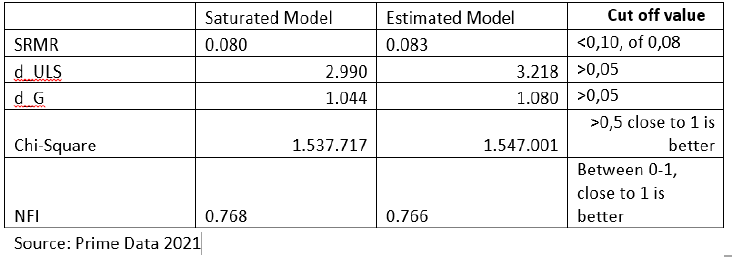
The data was processed using SmartPLS 3 and shows all the requirements for data fit to match the cut-off value for each measurement item.
Table 1: Respondent Profile
In Table 2, all indicators are fitted to the cut-off value, indicator numbers are not consecutive, and the missing numbers were removed because they did not meet the criteria.
Table 2: Outer Loading Show the Validity of each Indicantors Fit the Cutoff Criteria>07
The constructs reliability of table 3 demonstrates that all the requirements for internal consistency in the scale item are met and the value is higher than the cutoff point. This means the data can be processed to formulate the hypotheses.
Table 3: Construct Reliability Showa that the Instrument and the Variable are match to the Cut-off Value
The Model fit’s table 4 shows that the research models are fit and fit to formulate the hypotheses.
The overall result of the statistic measurement is available in the following image. Figure 2. is Path Diagram that shows overall result.
Table 4: Modle Fit Show the Research Modle match fit to the Criteria
Figure 2: Structural Equation Modeling (SEM) Path Diagram Showing Relationships among WQ, RI, CS, ERM, and RP
Source: Primary Data 2021
DISCUSSION
The following tables are used in the next discussion.
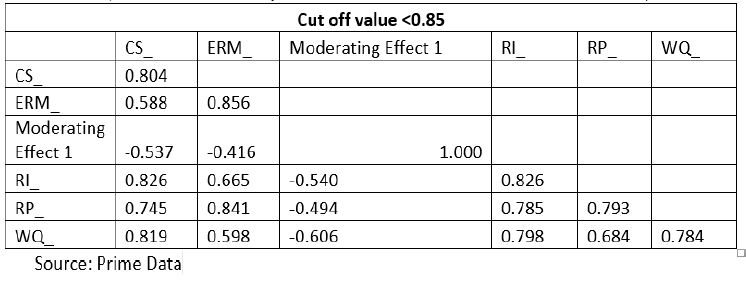
Table 5: Discriminant Validity Shows the Values are math the Cut-off Value Required
Table 6: R Quare
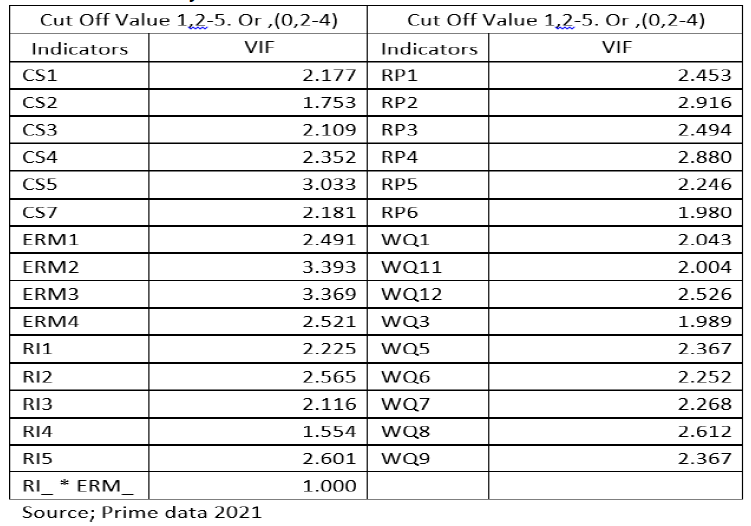
Table 7: Collinearity Statistic Show the Value are match the Criteria
The focus of the discussion is e-RM as a moderator between repurchase intentions and actual repurchases.The moderating effect can theoretically moderate the relationship between exogenous and endogenous variables [40]. This means that the moderating effect can change the strength or even the direction of the relationship between two variables.Based on this theory, e-RM as a moderating effect can change the strength of the relationship between repurchase intention and repurchase, or even change the direction of the relationship.
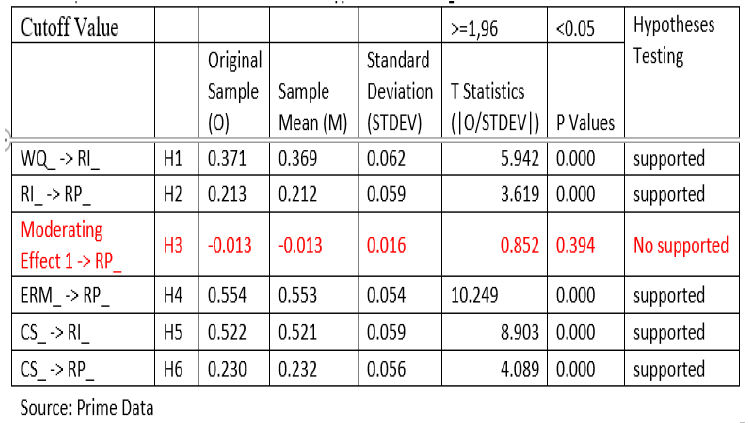
The hypothesis test shows that H3 is not supported, with a t-value of 0.85 (*1.967) and a p-value of 0.394 (>0.05), indicating that the moderating effect of e-RM is not significant.It means e-RM does not act as a moderator between repurchase and repurchase intentions, and the direction of the influence is negative, which shows that the moderating effect weakens the relationship. (Original sample -0.013). However, e-RM effects repurchase (H4), not as a moderator, but as an independent variable that determines repurchase.It is indicated by the t-value of 10,249, the p-value of 0.000, and the direction of the relationship is positive (0.553).It can be concluded that e-RM, where indicators include free shipping, discount promos, shopping coupons, and shopping point coupons, has not fully supported as a moderating effect on repurchase intention and repurchase.
Why does e-RM not contribute to strengthening the relationship as a moderator?A reason for this is the fact that there are terms and conditions when a customer wants free shipping or a discount.In general, online shop customers browse (choose the items they want to buy), click pay, specify the shipping cost, and then immediately cancel their order.As soon as the goods are priced at $75, suddenly there is no interest in continuing shopping since there is an additional shipping cost of $30 (Freeman, 2020).Discounts offered by online stores have similar conditions as free shipping.For instance, there is a 50% discount on certain items if the item has been prepared by the owner of the shop and if certain conditions are met.
E-RM, on the other hand, functions as an independent variable that shows a significant effect on the repurchase (H4 with t = 10.245, p = 0000).The current online free shipping and discount program does influence the online customer to repurchase.
Table 8: Path Coefficient Show the Result of Hypotheses Testing
The online store owners need to consider the variables used in this study to increase sales growth.First, Web quality contributes to increase repurchase intention (H1, t = 4.942, p = 0).ue = 0).According to the online customer profile, most respondents visit an online store once a week and open more than one store's website simultaneously.Furthermore, the repurchase intention has a significant effect on repurchase (H2, tCount = 3,619, p-Value = 0).Second, e-RM is a trigger for repurchase, especially among customers who already have repurchase intention. Third, customer satisfaction effects repurchase intention (H5 t-count = 8,903, p-Value = 0000), and customers who were satisfied with their previous experience affect repurchase (H6, t-count = 4,089. p-Value = 0).
According to Figure 2 and Table 6, R2 is 0.727.It indicates that 72.7% of the variables explaining the repurchase intentions are related to Web Quality and Customer Satisfaction.In other words, web quality plays a dominant role in emerging repurchase intention and supporting customer satisfaction.Furthermore, the Second R-Square value is 0.818. This means repurchase variables are explained by e-RM, repurchase intention, and customer satisfaction. In other words, e-RM, repurchase intention, and customer satisfaction significantly affect repurchase.
CONCLUSION
The main conclusion is that e-RM as a moderating effect of repurchase intention and repurchase (hypotheses 3) is not supported, whereas other hypotheses are. Web quality plays a major role in determining repurchase intention as well as customer satisfaction (R2 = 0,727). Another significant finding is the role of e-RM as an independent variable in influencing repurchase behavior. This means that the e-RM that is used by online retailers to maintain their customers increases sales growth.Customer who already has a repurchase intention that is affected by web quality and customer satisfaction is more likely to repurchase if they are satisfied, as indicated by R2 = 0.817.
REFERENCE
Cross, A. “What is customer relationship marketing? Definition of customer relationship marketing, strategies, benefits, and more.” NGData, January 2018, www.ngdata.com/what-is-customer-relationship-marke ting/.
Maulana, H.A. and Y. Asra. “Analisa pengaruh promo gratis ongkos kirim terhadap keputusan pembelian pada e-commerce oleh generasi Z di daerah pedesaan.” Jurnal Inovasi Bisnis, vol. 7, no. 2, 2019, pp. 162–165, www.ejournal.polbeng.ac.id/index.php/IBP.
Ardin, W.N. Pengaruh flash sale dan tagline ‘gratis ongkir’ Shopee terhadap keputusan pembelian impulsif secara online. Universitas Sumatera Utara, 2020.
Hafizhah, A.N. Pengaruh tagline gratis ongkir di aplikasi Shopee terhadap.... Universitas Muhammadiyah Malang, 2020, eprints.umm.ac.id/71094/.
Zheng, X. et al. “Examining e-loyalty towards online shopping platforms: The role of coupon proneness and value consciousness.” Internet Research, vol. 27, no. 3, 2017, pp. 709–726. https://doi.org/10.1108/IntR-01-2016-0002.
Vásquez, F. and J.V. Martínez. “From e-quality and brand perceptions to repurchase: A model to explain purchase behaviour in a web-store.” Journal of Theoretical and Applied Electronic Commerce Research, vol. 15, no. 3, 2020, pp. 20–36. https://doi.org/10.4067/S0718-18762020000300103.
Global Online, C. The truth about online consumers. KPMG International Cooperative, 2017.
Diamond, S. Digital marketing all-in-one. John Wiley & Son, 2019.
Steinhoff, L. et al. “Online relationship marketing.” Journal of the Academy of Marketing Science, vol. 47, 2019, pp. 369–393, https://doi.org/10.1007/s11747-018-0621-6.
Cobos, L. et al. “Assessing the web-based destination marketing activities: A relationship marketing perspective.” Journal of Hospitality Marketing & Management, vol. 18, no. 4, 2009, pp. 421–444, DOI:10.1080/19368620902799643.
Berry, M.J. and G.S. Linoff. Data mining techniques. 2nd ed., 2004.
Sharifi, S.S. and H. Aghazadeh. “Discount reference moderates customers’ reactions to discount frames after online service failure.” Journal of Business Research, vol. 69, no. 10, 2016, pp. 4075–4080, https://doi.org/10.1016/j.jbus res.2016.03.044.
Montazeri, S. et al. “Empirical decomposition of customer responses to discount coupons in online FMCG retailing.” Journal of Retailing, 2020.
Utami, N.W. “Memahami promo free ongkir yang semakin berkembang.” October 2017.
Recommended Articles
Research Article
Analysis of the Influence of Leadership Style, Compensation Commitment and Work Stress on Performance (Case: Almarhamah Foundation Employee Padang Pariaman Regency)
Download PDF
Research Article
Marketing Agility: A Multi Layer Perspektif SME opportunities in Indonesia
Download PDF
Research Article
The Effect of Local Tax and Retribution on Direct Expenditure with Special Autonomy Fund as a Moderation In Districts / Cities of Aceh Province, Indonesia
Download PDF
Research Article
Consumer Behavior and the Effect of Covid-19 on Markets: An Empirical Study
Download PDF
PO Box 101, Nakuru
Kenya.
Email: office@iarconsortium.org
Editorial Office:
J.L Bhavan, Near Radison Blu Hotel,
Jalukbari, Guwahati-India
Muchtar, A. M., Purwoko, B. & Hatta, I. H. (2022). Moderating Effect of Electronic Relationship Marketing Between Repurchase Intention and Repurchase, Evidence from Indonesian Online Store Customer. IAR Journal of Business Management, 3(2), 1-8.
MLA
Muchtar, Ali M., Bambang Purwoko and Iha H. Hatta. "Moderating Effect of Electronic Relationship Marketing Between Repurchase Intention and Repurchase, Evidence from Indonesian Online Store Customer." IAR Journal of Business Management 3.2 (2022): 1-8.
Chicago
Muchtar, Ali M., Bambang Purwoko and Iha H. Hatta. "Moderating Effect of Electronic Relationship Marketing Between Repurchase Intention and Repurchase, Evidence from Indonesian Online Store Customer." IAR Journal of Business Management 3, no. 2 (2022): 1-8.
Harvard
Muchtar, A. M., Purwoko, B. and Hatta, I. H. (2022) 'Moderating Effect of Electronic Relationship Marketing Between Repurchase Intention and Repurchase, Evidence from Indonesian Online Store Customer' IAR Journal of Business Management 3(2), pp. 1-8.
Vancouver
Muchtar AM, Purwoko B, Hatta IH. Moderating Effect of Electronic Relationship Marketing Between Repurchase Intention and Repurchase, Evidence from Indonesian Online Store Customer. IAR Journal of Business Management. 2022 Jul;3(2):1-8.



 Download PDF
 Download XML