The Effect of Transformational Leadership, Work Motivation, and Organizational Commitment on Job Satisfaction and Performance on Medical and Paramedical Personnel (Case Study at Public Health Center in Indonesia)
Novie Noordiana Rachma Yulia
1
,
Suryati Eko Putro
1
,
Arlisa Indriawati
1
1
Lecture of Management Department, Universitas Teknologi Surabaya, Indonesia
Human resources play a very important role because humans are the cogs of all company activities. Efforts to improve performance are carried out through a well-organized leadership system and motivating to increase employee morale. This study aims to determine the effect of transformational leadership, work motivation, and organizational commitment on employee performance. This study uses a survey method with a questionnaire as a data collection tool. The population in this study were all medical and paramedical personnel at the Public health center in Surabaya, Indonesia, totaling 60 people. Samples were taken as many as 60 employees with the sampling technique of Non-Probability Sampling with Saturated Sampling, where all members of the population became the sample. The data obtained through the questionnaire were then tested for validity and reliability using the product-moment correlation formula and Cronbach's alpha. Data analysis used multiple regression analysis, F test, t-test, and coefficient of determination test and was accompanied by classical assumption testing. The results showed that Individual/partial transformational leadership did not affect the performance of medical and paramedical officers at Public health center in Surabaya, Indonesia. This is evident from the results of the t-test to obtain a t-value of 1.028 with a t-table of 2.05 with a significance level of 5%. This means that transformational leadership that is carried out partially without being followed by work motivation and organizational commitment will not affect employee performance. Work motivation has a positive effect on the performance of medical officers and paramedics at the Public Health Center in Surabaya, Indonesia. The t-test result shows a t-value of 34.013, which is higher than the t-table value of 2.05 at a 5% significance level; therefore, H2 is accepted. This indicates that higher work motivation leads to better employee performance. Similarly, organizational commitment also positively affects performance, with a t-value of 3.478 exceeding the t-table value of 2.05 at the 5% significance level. Thus, H3 is accepted, meaning that increased organizational commitment improves employee performance.
Keywords
Transformational Leadership
Work Motivation
Organizational Commitment
Employee Performance
INTRODUCTION
The changing organizational environment that is increasingly complex and competitive requires companies to be more responsive to survive. In organizational change, both planned and unplanned, the most important aspect is individual change. Change in the individual is not easy but must go through the process. Leaders are role models in the organization, so change must start from the top-level (the leader). For this reason, organizations need reformist leaders who can become the driving force of organizational change. This also applies to health care institutions. Public health center is one of the health institutions that is visited by many people. Environmental developments require public health center to manage and provide better services.
The challenge in developing a clear organizational strategy mainly lies in the organization on the one hand and depends on leadership [1]. Meanwhile, to have effectiveness, Green Berg and Baron [2] in Sunarsih [1] state that leadership is a key element in organizational effectiveness. Along with changes in the organizational environment that is increasingly complex and competitive, it demands the readiness of leaders to keep the company afloat. The latest leadership models such as organizational transformation leadership will play an important role for every organization.Transformational leadership includes developing closer relationships between leaders and followers, not just an agreement but more based on trust and commitment [1].
Bass in Sunarsih [1] and Swandari [3] defines transformational leadership as a leader who has the power to influence subordinates in certain ways. Subordinates feel trust, admiration, loyalty, and respect for their superiors so that subordinates are motivated to do more than what is usually done and expected. Transformational leadership in principle motivates subordinates to do better than what is usually done, in other words, it can increase the confidence or self-confidence of subordinates which will affect work improvement.
A leader can transform his subordinates through four components Alam Muchiri, 2000: 123 - 124 in Sunarsih, which consists of:
The Effect of Idealism. Leaders who have charisma show conviction, emphasize trust, place themselves on difficult issues, demonstrate the most important values, emphasize the importance of goals, commitment, and ethical consequences of decisions, and have a vision and sense of mission. Thus, the leader will be imitated, arouse pride, loyalty, respect, enthusiasm, and trust of subordinates. In addition, the leader will make subordinates have confidence
Inspirational Motivation. The leader has an attractive vision for the future, sets high standards for subordinates, is optimistic and enthusiastic, provides encouragement and meaning to what needs to be done. So, this kind of leader will increase the optimism and enthusiasm of subordinates and motivation and inspire subordinates to exceed initial motivational expectations through emotional support and emotional appeal
Intellectual Stimulation. Leaders who encourage subordinates to be more creative, eliminate the reluctance of subordinates to issue ideas, and in solving existing problems use new approaches that use more intelligence and rational reasons than based solely on opinions or estimates
Individual Consideration. Leaders can treat others as individuals, consider individual needs and aspirations, listen, educate and train subordinates. So that this kind of leader gives personal attention to his subordinates who see subordinates as individuals and offers special attention to developing subordinates for good performance
To support the success of management requires a leader who can carry out the duties and functions of management. A good leader must be able to motivate to achieve work productivity and job satisfaction of his subordinates.
According to Reksohadiprojo and Handoko [4] in Suranta [5] motivation is a condition in a person's personality that encourages the individual's desire to carry out certain activities to achieve a goal. The motivation that exists is when a person will realize a behavior that is directed at the goal of achieving the goal of satisfaction. So, motivation is not something that can be observed but is something that can be concluded because of something visible behavior.
A critical factor related to the long-term success of an organization is how well the company's ability to measure how well employees work and use information. Job appraisal can help foster motivation and improve the quality of employees, so support from superiors and all parties is needed to be more effective.
According to Milkovich and Boudreau [6] in Wahyuningsih [7] performance is a level where employees meet or achieve the specified work requirements. Performance is a record of the outcomes resulting from a particular job or activity during a certain period.
Previous Research
Natsir [8] concluded that there is a direct but significant negative effect of transformational leadership on employee performance. The findings of this study mean that banking employees in Central Sulawesi feel that their leaders motivate them to do their jobs more than they should, with the hope of becoming leaders in the future by solving problems by reviewing from various points of view, encouraging creativity, exploring ideas. innovative ideas in completing tasks, and make employees ignore their interests in the interests of the group, and look to try to understand every problem,
Rokhman and Harsono [9] concluded that the regression results showed a positive and significant add-on effect of 19.3%. The transformational leadership factors were able to provide an additional explanation of the variance in subordinate satisfaction of 19.7% more than could be explained by the leadership factors. With the characteristics of respect for subordinates and stimulating subordinates to be more creative and develop their abilities as a means of self-actualization to lead to the self-satisfaction of subordinates, then this greatly affects the satisfaction of subordinates with transformational leadership.
Utami [10] based on the results of the t-test, it can be seen that transformational leadership has a value of t count (3.507) > t table (2.0117) with a significance of 0.001 then H0 is rejected and H1 is accepted so that it can be concluded that transformational leadership has a significant influence on employee performance while motivation work has a value of t count (2.058) t table (2.0117) with a significant 0.045 then H0 is rejected and H1 is accepted so that it can be concluded that work motivation has a significant influence on employee performance. Based on the results of the F test, shows that the independent variables, namely transformational leadership, and work motivation simultaneously influence employee performance as the dependent variable. The influence it has is strong because the value of F count (10,429).
Suranta [5] based on the results of the one-way ANOVA analysis to examine the effect of leadership style on employee performance showed that the value of F = 6.890 and p = 0.001. In addition, the t-test analysis shows that the value of t = 2.625 and p = 0.010. so, it can be concluded that leadership style has a significant influence on employee performance, while the results of the two-way ANOVA analysis to examine the effect of the interaction of leadership style and employee motivation on employee performance shows that the significance value of F is 0.202. The results of this analysis do not support, because the significance value of F is greater than 0.05. this means that employee motivation does not moderate the influence of leadership style on employee performance.
Baihaqi [11] organizational commitment has a positive and significant effect on job satisfaction and employee performance as seen from the results of the analysis test using regression that the F-test value is 9,242 with a significance of 0.000. Because the significance price is less than 0.05, it indicates that the F-test value obtained is significant so that the linear regression model of this study can be used to explain the effects of the independent variables, namely leadership style and organizational commitment simultaneously on the dependent variable, namely employee job satisfaction.
Anikmah with research results shows that:
Transformational leadership has a positive effect on the performance of employees of PT. Jati Agung Arsitama. This is evident from the results of the t-test to obtain a t count of 4.223, with a significance level of 5% (p<0.05) and H1 being accepted. This means that the better the transformational leadership that is carried out, the employee's performance will increase
work motivation has a positive effect on the performance of employees of PT. Jati Agung Arsitama. This is evident from the results of the t-test to obtain a t count of 6.329, with a significance level of 5% (p<0.05) and H2 being accepted. This means that the higher the employee's work motivation, the performance will increase
Transformational Leadership
Leadership is the ability to influence subordinates or groups to work together to achieve organizational or group goals. Bass in Swandari [3] defines transformational leadership as a leader who has the power to influence subordinates in certain ways, with the application of transformational leadership subordinates will feel trusted, valued, loyal and respectful to their leaders. In the end, subordinates will be motivated to do more than expected. O'Leary [12] transformational leadership is the leadership style used by a manager when he wants a group to expand and perform beyond the status quo or achieve an entirely new set of organizational goals. Transformational leadership in principle motivates subordinates to do better than what can be done, in other words, it can increase the confidence or self-confidence of subordinates which will affect performance improvement. Based on the above opinion, it can be concluded that transformational leadership includes efforts to change subordinates to do more positively or better than what is usually done which affects increasing performance.
Work Motivation
Motivation is very important and must be started by everyone to increase work productivity. Motivation comes from the Latin "Movere", which means to move (to move). In essence, human behavior is motivated by the desire to get something which is the goal of the activity. The meaning of motivation is as a person's needs, desires, impulses, impulses. According to Flippo [13] says that motivation is a skill in integrating the interests of employees and the interests of the organization so that the desires of employees are satisfied along with the achievement of organizational goals. Meanwhile, Reksohadiprojo and Handoko [4] define that motivation as a condition in a person's self that encourages an individual's desire to carry out certain activities to achieve a goal. The motivation that exists in a person will realize a behavior that is directed at the goal of achieving the goal of satisfaction. So, motivation is not something that can be concluded because of something visible behavior. Motivation is the spirit or drive in a person to carry out certain activities to achieve a goal that can have a positive effect on achieving performance. So, motivation is not something that can be concluded because of something visible behavior. Motivation is the spirit or drive in a person to carry out certain activities to achieve a goal that can have a positive effect on achieving performance. So, motivation is not something that can be concluded because of something visible behavior. Motivation is the spirit or drive in a person to carry out certain activities to achieve a goal that can have a positive effect on achieving performance.
One of the earliest and most popular motivational models was put forward by Maslow in Reksohadiprojo and Handoko [4] who was one of the experts who revealed the theory of motivation, he considered several needs to explain human behavior, and suggested that these needs have a hierarchy; that some needs are at a lower level than others. He also argued that unless the lower-level needs were met, the higher needs would not function and once the lower needs were met, these needs would not motivate people.
Organizational Commitment
Robbins [14], employee commitment to an organization is a condition in which employees take sides with a particular organization and its goals, and intend to maintain membership in that organization.
Husselid and Day state that employee commitment can reduce the desire to leave the organization or work unit. They tend to show high involvement manifested in the form of attitudes and behavior. In addition, employees who show an attitude of commitment will feel happier with their work, waste less time at work, and less likely to leave the work environment. The existence of a sense of attachment to the philosophy and work unit is likely to survive in the work unit will be higher than employees who do not have a sense of attachment to the work unit. According to Husselid and Day it is said that employee commitment can reduce the desire to leave the organization or work unit. They tend to show high involvement manifested in the form of attitudes and behavior. High organizational commitment is needed in an organization because the creation of high commitment will affect a professional work situation. Talking about organizational commitment cannot be separated from the term loyalty which often follows the word commitment. This understanding makes the terms loyalty and commitment have a confusing meaning. Organizational commitment, according to Alwi, is the attitude of employees to remain in the organization and be involved in efforts to achieve the mission, values, and goals of the organization. It was further explained that commitment is a more concrete form of loyalty that can be seen from the extent to which employees devote attention, ideas,
According to Luthans [9] that as an attitude, organizational commitment is a strong desire or motive to remain a member of the organization; a desire to demonstrate a high level of effort on behalf of the organization; and a strong belief in accepting the values and goals of the organization. Commitment is a condition in which employees take sides and care for a particular organization and its goals, and intend to maintain membership in that organization. This form of partisanship and concern for employees can be done in various ways, such as being involved in organizational activities, reducing time-wasting at work, and reducing the possibility of leaving the work environment.
Mowday et al. [10]. Based on Mowday's opinion, there are three main factors to see the organizational commitment of an individual, namely:
A strong belief in and acceptance by the individual of the goals and values of the organization
Willingness to work harder to achieve organizational goals
Strong desire to maintain membership in the organization
Meanwhile, the opinion of Allen and Meyer [13] classifies organizational commitment into three dimensions, namely: affective commitment, continuance commitment, and normative commitment.
Furthermore, Allen and Meyer [13] briefly illustrate the differences between the three dimensions as follows: "Employees with strong affective commitment remain because they want to, those with strong continuance commitment remain because they need to, and those with strong normative commitment because they feel they thought to do so".
Based on the opinion of Allen and Meyer, it can be interpreted that a person's decision to stay in the organization has different motivations. A person with a strong affective commitment stays in the organization, because he likes the organization, while someone with a strong continuance commitment stays in the organization, for reasons of survival as his main motivation. Meanwhile, someone with a strong normative commitment stays in the organization for reasons of morality. However, regardless of the source of commitment, substantially the form of commitment is the same, namely the individual's acceptance of the goals and values of the organization, the individual's willingness to strive to achieve organizational goals, and the desire to maintain membership in the organization.
So, to measure the commitment variable used 3 main dimensions as proposed by Allen and Meyer. The three dimensions of commitment are affective commitment, continuance commitment, and normative commitment.
Employee Performance
Simamora [15] suggests that employee performance is the level at which employees achieve job requirements. Meanwhile, Suprihanto says that the performance or performance of an employee is the result of an employee's work during a certain period compared to possibilities, for example, standards, targets or targets or performance that has been determined in advance and has been mutually agreed upon.
Employee performance is the work achieved by an employee following the authority or responsibility of each employee during a certain period.
The methods for performance appraisal according to Mathis and Jackson [16], namely: category assessment method, comparison method, narrative method, goal or behavior method.
Some of the error raters according to Mathis and Jackson [16], among others: the problem of using different standards, the recession effect, the error tends to converge, the error of slack and rigidity, the bias of the assessment, the halo effect, and the contrast error.
Relationship Between Transformational Leadership and Motivation on Performance
The most important function of leadership is to motivate subordinates; transformational leadership is believed to have an influence on the company in non-financial firms such as job satisfaction and employee performance. Transformational leaders motivate their followers to do something (performance) beyond expectations (beyond normal expectations) through the transformation of their thoughts and attitudes to achieve performance beyond expectations, transformational leaders exhibit the following behaviors: the influence of idealism, inspirational motivation, intellectual stimulation, and individual considerations. According to Alberto et al. [17] leadership has a strong positive effect on performance, it also has a significant effect on organizational learning.
The Relationship Between Motivation and Performance
An important determinant of individual performance is motivation. But motivation is not the only determinant, other variables: such as the effort exerted, experience ability also affects performance. From this statement, it can be said that performance is influenced by motivation.
With motivation, there is a will to work and with a willingness to work and with cooperation, performance will increase. Employee performance is a measure of company performance, the higher the employee's performance, the higher the company's performance.
The Influence of Leadership Style and Work Motivation on Performance
Leaders have the responsibility of creating the conditions and incentives that motivate members to achieve the stated goals. Motivation or encouragement can have an impact on positive behavior, namely providing moral or negative impact, pressure. A person's leadership style greatly influences a person's ability to influence individuals or groups, so that the behavior of subordinates is under organizational goals, there must be a combination of motivation to fulfill their own needs and organizational demands.
Research Concept Framework
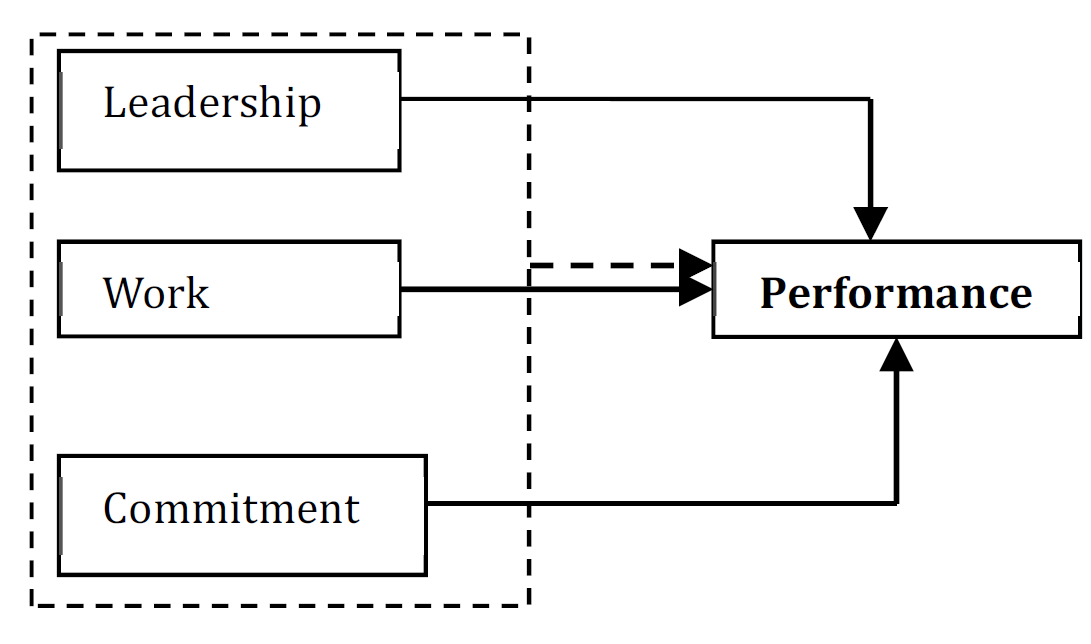
In this study, the author presents a theoretical framework to make it easier to understand the problem being studied. The estimation of this theoretical framework is presented in the form of a schematic or picture showing the relationship of each variable, namely as follows (Figure 1).
Research Concept Framework
The model was adapted from the research model of Baihaqi [11] and Anikmah.
There are 4 (four) dimensions of transformational leadership, namely: the influence of idealism, inspirational motivation, intellectual stimulation and individual considerations which are independent variables or independent variables. For motivation, there are 5 (five) dimensions, namely: fulfillment of physiological needs, fulfillment of security needs, fulfillment of social needs, fulfillment of esteem needs, and fulfillment of self-actualization needs. The three dimensions of organizational commitment from Meyer and Allen that we can use as indicators are as follows:
Affective Commitment: become a member of an organization because it is desired
Continuance Commitment: become a member of an organization because of need
Normative Commitment: become a member of an organization because they feel obligated. While employee performance is the dependent variable or dependent variable
H2: Work motivation influences employee performance.
H3: Organizational commitment has a positive and significant effect on employee job satisfaction.
Figure 1: Research Concept Framework
MATERIALS AND METHODS
Location and Time of Research
The research was conducted in Indonesia. When this research was carried out in early 2020.
Population
This type of research is quantitative. This study uses secondary data. According to Sugiyono, secondary data is data obtained from parties/institutions/other sources. Secondary data is used to determine remittances of Indonesian migrant workers. Secondary data used is a time series for a period of 11 years, in the year of 2006-2016.This study uses data collection methods in the form of:
Questionnaire method using a list of written questions given to respondents to be answered following the available alternative answers. This questionnaire consists of several questions related to the identity of the respondents, respondents' responses to transformational leadership, respondents' work motivation, respondents' organizational commitment, and respondents' performance
Interview method in the form of direct interviews with the public health center in Surabaya, Indonesia on records and reports to obtain secondary data that supports this research, namely data on the number of medical and paramedical personnel (overview of medical and paramedical personnel) at the public health center in Surabaya, Indonesia
To test the proposed hypothesis used multiple linear regression analysis tools, t test and F test. Multiple Linear Regression was used to examine the effect or relationship between the independent variables (Transformational Leadership and Work Motivation) and the dependent variable (Performance of medical and paramedical personnel). Calculations will be carried out with the help of the SPSS for Windows program. The variable relationship model will be analyzed according to the regression equation:
Y = + 1X1 + 2X2 + 3X3 i
Where:
Y = Performance of medical and paramedical personnel
X1 = Transformational Leadership
X2 = Work Motivation
X3 = Organizational Commitment
Α = constant
β1, β2, β3 = Regression Coefficient
Σi = error
The classical assumption test is also used to detect whether or not there is a deviation from the classical assumption on the multiple regression equation used. This test consists of the normality test, multicollinearity test, and heteroscedasticity test.
RESULTS AND DISCUSSION
The results of the questionnaire show that most of the respondents who are medical and paramedical personnel at the Surabaya "X" Health Center, which are female, are as much as 90%. While the remaining 10% are male medical and paramedical personnel. Most of the respondents have a working period of 0-5 years, which is 70% and the lowest is respondents who have a service period of between 6-10 years, which is 7%, more than 10 years, as much as 23%.
From the results of the regression analysis, the following equation is arranged:
Y = -0.487 + 0.027X1 + 0.910X2 + 0.094X3
The equation shows that employee performance is influenced by transformational leadership and work motivation. The constant value of -0.487 states that if there is no increase in transformational leadership and work motivation, then the performance score is reduced by 0.487 units. The transformational leadership coefficient value of 0.027 states that if there is an increase in transformational leadership by one unit, the employee's performance will increase by 0.027 units. The value of the work motivation coefficient of 0.910 states that if there is an increase in work motivation of one unit, the employee's performance will increase by 0.910 units. Organizational commitment coefficient value is 0, from the results of data processing obtained Fcount = 1.007.533 while Ftable at a significance level of 5% with df (3:26) is 2.98. Due to F count > Ftable (1007,533 > 3,23), it means that the regression model about the influence of transformational leadership and work motivation on employee performance is fit. This shows that transformational leadership, work motivation, and organizational commitment jointly affect the performance of medical and paramedical officers at the "X" Public Health Center Surabaya.
From the tests that have been carried out, the coefficient of determination R2 is 0.991, so it can be said that the results of the tests carried out gave good results (goodness of fit). This shows that about 99.1% of the variation of employee performance can be explained by the variables of transformational leadership, work motivation, and organizational commitment. While the other 0.9% can be explained by other variables outside the model.
The results of testing the first hypothesis with the t-test obtained a value of t count = 1.028 rejected at a significance level of 5%. This means that transformational leadership does not have a positive and significant effect on employee performance. Transformational leadership if applied alone without being followed by motivation and organizational commitment will not affect employee performance. Transformational leadership is leadership that works towards goals in the act of directing the organization to a goal that has never been achieved before. Real leaders must be able to direct the organization in a new direction. Transformational leadership involves changes in the organization that require action to motivate subordinates to be willing to work for high-level goals that are considered to be beyond their interests at the time. Tjiptono and Syakhroza suggest that transformational leaders can successfully change the status quo in their organizations by practicing appropriate behavior at each stage of the transformation process. If the old ways are deemed no longer appropriate, the leader will develop a new vision of the future with a strategic and motivational focus. The vision clearly states the goals of the organization and at the same time serves as a source of inspiration and commitment for employees to perform optimally. Tjiptono and Syakhroza suggest that transformational leaders can successfully change the status quo in their organizations by practicing appropriate behavior at each stage of the transformation process. If the old ways are deemed no longer appropriate, the leader will develop a new vision of the future with a strategic and motivational focus. The vision clearly states the goals of the organization and at the same time serves as a source of inspiration and commitment for employees to perform optimally. Tjiptono and Syakhroza suggest that transformational leaders can successfully change the status quo in their organizations by practicing appropriate behaviour at each stage of the transformation process. If the old ways are deemed no longer appropriate, the leader will develop a new vision of the future with a strategic and motivational focus. The vision clearly states the goals of the organization and at the same time serves as a source of inspiration and commitment for employees to perform optimally.
The results of this study successfully support the results of the research in this thesis, that transformational leadership can have a positive and significant effect on employee performance if it is followed by actions of work motivation and organizational commitment. Consistent with the results of previous research by Utami (2006) which proves that leadership has a positive effect on employee performance.
The results of testing the second hypothesis with the t-test obtained a value of t count = 34,013 accepted at a significance level of 5%. This means that individually / partially work motivation has a positive and significant effect on employee performance. The higher the employee's work motivation, the performance will increase. Conversely, the lower the employee's work motivation, the employee's performance will also decrease. Employee performance will increase if employees have a high motivation or drive to work. Motivation or encouragement to work can be increased by incentive stimuli (rewards) for achievers. Managers or company leaders can motivate (stimulate their subordinates) by giving gifts to those who excel. The prize is of course tailored to the urgent needs of employees. With this positive motivation, the work spirit of subordinates will increase. Because the behaviour or actions of each individual at a certain time is usually determined by an urgent need. Therefore, every manager who wants to motivate his subordinates needs to understand hierarchy rather than human needs.
The results of this study successfully support hypothesis H2 that work motivation has a positive and significant effect on employee performance. Consistent with the results of previous research by Utami (2006) which proves that work motivation has a positive effect on employee performance. The results of testing the third hypothesis with the t-test obtained a value of t count = 3,478 accepted at a significance level of 5%. This means that individual/partial organizational commitment has a positive and significant effect on employee performance. The higher the employee's organizational commitment, the performance will increase. On the other hand, the lower the employee's organizational commitment, the lower the employee's performance will be. Employee performance will increase if employees have a high organizational commitment. Organizational commitment plays an important role in improving good performance and neglect of commitment to the organization will cause losses. Organizational commitment is a consistency of a person's attachment to the organization. The existence of the right commitment will provide high motivation and have a positive impact on the performance of a job. So, it supports the research conducted by McNeese-Smith [18], Benkhoff, Harrison and Hubard and Sri Trisnaningsih.
CONCLUSION
From the results of data analysis and discussion, the following conclusions can be drawn:
Partial/individual transformational leadership does not have a positive effect on the performance of medical and paramedical personnel at public health center in Surabaya, Indonesia. This is evident fromthe results of the t-test obtained a tcount of 1.028 while the results of the t-table were 2.05 with a significance level of 5%. This means that if transformational leadership is carried out individually/partially without being followed by work motivation and organizational commitment variables, then employee performance will not be affected
Work motivation has a positive effect on the performance of medical and paramedical personnel at public health center in Surabaya, Indonesia. This is evident from the results of the t-test to obtain a t-value of 34.013 while the results of the t-table are 2.05 with a significance level of 5%, meaning that H2 is accepted. This means that the higher the employee's work motivation, the performance will increase, even without followed by the application of transformational leadership variables and organizational commitment
Organizational Commitment has a positive effect on the performance of medical and paramedical personnel at public health center in Surabaya, Indonesia. This is evident from the results of the t-test to obtain a t count of 3.478 while the results of the t-table are 2.05 with a significance level of 5%, meaning that H3 is accepted. This means that the higher the employee's organizational commitment, the performance will increase, even without being followed by the application of transformational leadership and work motivation variables
Research Limitations
The researcher realizes that this study has several limitations that may affect the results of the study. These limitations are as follows:
As has been reviewed in the literature review that transformational leadership, work motivation, organizational commitment, and performance are very complex and many factors influence them, then in using the results of this study as a policy basis. This is realized by the researcher as a limitation
Limitations in taking the number of research samples, which are limited to medical and paramedical personnel at public health center in Surabaya, Indonesia, while in other organizations or bodies that are larger, the organizational structure has not been included, so the level of generalization is lacking
The limitation of the survey method is that the researcher cannot control the respondents' answers, so that other people may fill out this questionnaire which is not following the characteristics and opinions of the respondents concerned
This study uses a data collection method in the form of a questionnaire with an interval scale in the form of a rating (Likert scale) as a measurement scale. The Likert scale used in this study was 5, namely strongly agree, agree, neutral, disagree, and strongly disagree. The tendency of questionnaires that use an odd scale is that respondents who do not understand the question or questionnaire statement tend to give neutral answers
The subjectivity of the respondents may result in the results of this study being vulnerable to bias in the respondents' answers. This is realized by the researcher as a limitation in research that uses primary data. Therefore, the results of this study should be interpreted with caution
Hopefully, the limitations of this research will be input for research furthermore to become an illustration to provide research results that are even better.
Suggestion
From the results of research, data analysis, discussion, and conclusions that have been drawn, the following suggestions can be put forward:
For future research, the sample and research area should be further expanded, which is not limited to medical and paramedical personnel at public health center in Surabaya, Indonesia or in the Surabaya area, but surveys are carried out on more than one public health center, so that the level of generalization is better
For future research, the research instrument should be deepened and developed again so that the ability to measure it is better. Because many other factors affect employee performance
Future research agendas should further develop this model by adding other variables that are still closely related, for example, work stress, motivation, compensation, or other indicators
The scale used in this study has odd intervals. The tendency of questionnaires that use odd intervals is that respondents who do not understand the question or questionnaire statement will choose the middle interval, which is neutral. So that in future research, it is recommended that researchers use even intervals by eliminating neutral choices
For the Public health center "X" it is expected that in implementing transformational leadership policies, it is also followed by an increase in work motivation and organizational commitment simultaneously
The Public health center leadership is expected to hold more frequent activities that can increase work motivation and commitment to the organization because it has been proven to have a significant effect on employee performance
REFERENCE
Djarwanto, P.S. and Pangestu Subagyo. Statistik Induktif. 4th ed., BPFE, 1993.
Flippo, E.B. Manajemen Personalia. Translated by Masud Moh, 6th ed., Book II, Erlangga, 1990.
Ghozali, I. Aplikasi Analisis Multivariate Dengan Program SPSS. 3rd ed., 2005.
Handoko, H.T. and Sukanto Reksohadiprodjo. Organisasi Perusahaan. 2nd ed., BPFE, 1996.
Heidrajrahcman, and Suad Husnan. Manajemen Personalia. BPFE, 2000.
Kartono, K. Pemimpin dan Kepemimpinan. Rajawali, 1983.
Luthans, F. Organizational Behavior. McGraw Hill International, 1996.
Mathis, R.L. and J.H. Jackson. Manajemen Sumber Daya Manusia. Book 2, Salemba Empat, 2001.
Baihaqi, M.F. “Pengaruh gaya kepemimpinan terhadap kepuasan kerja dan kinerja dengan komitmen organisasi sebagai variabel intervening (Studi pada PT. yudhistira ghalia Indonesia area Yogyakarta).” Skripsi Akuntansi, Fakultas Ekonomi, Universitas Muhammadiyah Surakarta, 2010.
Natsir, S. “Pengaruh gaya kepemimpinan transaksional dan transformasional terhadap perilaku kerja dan kinerja karyawan perbankan di Sulawesi Tengah.” Majalah Ekonomi, vol. 14, no. 1, April 2005.
Nawawi, H.H. and M.H. Martini. Metode Diskriptif Penelitian Terapan. UGM Press, 1994.
O’Leary, E. Kepemimpinan. 1st ed., Andi, 2001.
Rokhman, W. and Harsono. “Peningkatan pengaruh kepemimpinan transformasional terhadap kepemimpinan transaksional pada komitmen organisasi dan kepuasan Bawahan.” Empirika, vol. 11, June 2002.
Sevilla, C.G. et al.Pengantar Metode Penelitian. Translated by Alimuddin Tuwu, Universitas Indonesia, 1993.
Simamora, H. Manajemen Sumber Daya Manusia. 2nd ed., STIE YKPN, 1997.
Sunarsih. “Kepemimpinan transformasional dalam era perubahan organisasi.” Jurnal Manajemen dan Bisnis, vol. 5, no. 2, December 2001, pp. 106–116.
Suranta, S. “Dampak motivasi karyawan pada hubungan antara gaya kepemimpinan dengan kinerja karyawan Perusahaan Bisnis.” Jurnal Penelitian Ekonomi Bisnis dan Pembangunan, vol. 15, no. 2, December 2002, pp. 116–138.
Swandari, F. “Menjadi perusahaan yang survive dengan transformasional leadership.” Jurnal Ekonomi, Manajemen dan Akuntansi, vol. 1, no. 2, May 2003, pp. 93–102.
Utami, S. “Pengaruh kepemimpinan transformasional dan motivasi kerja terhadap kinerja karyawan PT jati agung arsitama grogol sukoharjo.” Skripsi, Universitas Sebelas Maret, 2006.
Wahyuningsih, T. “Sistem penilaian kinerja sebagai motivator karyawan.” Jurnal Manajemen dan Bisnis, vol. 7, no. 1, June 2003, pp. 44–55.
Recommended Articles
Research Article
Analysis of the Influence of Leadership Style, Compensation Commitment and Work Stress on Performance (Case: Almarhamah Foundation Employee Padang Pariaman Regency)
Download PDF
Research Article
Marketing Agility: A Multi Layer Perspektif SME opportunities in Indonesia
Download PDF
Research Article
Consumer Behavior and the Effect of Covid-19 on Markets: An Empirical Study
Download PDF
Research Article
Developing Social Media Marketing Visual Contents to Increase Engagement Rate (A Case Study of Healthy Tails Animal Clinic in Malang City)
Aditya Nirwana,
...
Felicia Joscelind Verrel
Published: 20/11/2022
Download PDF
PO Box 101, Nakuru
Kenya.
Email: office@iarconsortium.org
Editorial Office:
J.L Bhavan, Near Radison Blu Hotel,
Jalukbari, Guwahati-India
Yulia, N. N. R., Putro, S. E. & Indriawati, A. (2022). The Effect of Transformational Leadership, Work Motivation, and Organizational Commitment on Job Satisfaction and Performance on Medical and Paramedical Personnel (Case Study at Public Health Center in Indonesia). IAR Journal of Business Management, 3(1), 1-8.
MLA
Yulia, Novie N. R., Suryati E. Putro and Arlisa Indriawati. "The Effect of Transformational Leadership, Work Motivation, and Organizational Commitment on Job Satisfaction and Performance on Medical and Paramedical Personnel (Case Study at Public Health Center in Indonesia)." IAR Journal of Business Management 3.1 (2022): 1-8.
Chicago
Yulia, Novie N. R., Suryati E. Putro and Arlisa Indriawati. "The Effect of Transformational Leadership, Work Motivation, and Organizational Commitment on Job Satisfaction and Performance on Medical and Paramedical Personnel (Case Study at Public Health Center in Indonesia)." IAR Journal of Business Management 3, no. 1 (2022): 1-8.
Harvard
Yulia, N. N. R., Putro, S. E. and Indriawati, A. (2022) 'The Effect of Transformational Leadership, Work Motivation, and Organizational Commitment on Job Satisfaction and Performance on Medical and Paramedical Personnel (Case Study at Public Health Center in Indonesia)' IAR Journal of Business Management 3(1), pp. 1-8.
Vancouver
Yulia NNR, Putro SE, Indriawati A. The Effect of Transformational Leadership, Work Motivation, and Organizational Commitment on Job Satisfaction and Performance on Medical and Paramedical Personnel (Case Study at Public Health Center in Indonesia). IAR Journal of Business Management. 2022 Jan;3(1):1-8.


 Download PDF
 Download XML