Today’s toughest challenge for manager’s to make the employees ever ready for best performance. Every organization success is mostly depends on the employees. Human resource is the only powerful key to compete and cope with changes. For an employee the organization is like their home and they never wants to go away from the home, if they live happily. It's a continuous challenge for manager to engage and motivate employees. Thus the managers are continuously trying to boost motivation of workforce for better performance. Most influential researcher about human behavior like Abraham Maslow, Herzberg, Adam Smith and Sigmurl Freud have taught us about human behavior. In the book by Paul R. Lawrence and Nitin Nohria driven how human nature shapes our choices. They are drives to Acquire, Bond: from connections with individuals and groups, Comprehend: Satisfy our curiosity and master the world around us, Defend: protect against external threats and promote justice. By using this model this study focused on deeper understanding of relationship of engage and motivate employee with their performance and insights into human behavior, which help the organization get the best out of employees by fulfilling fundamental needs.
Keywords
Motivation
Acquire
Bond
Comprehend
Defend
INTRODUCTION
Motivation is the force that drives our actions. Some people climb mountains, while some run and others just sit. These are three separate acts that rely only on motivation. Differences in acts are outcome of motivation. This makes the difference between thought and exceptional results. "Without motivation, the effort of the individual is only zero, "Employee motivation is a very vital for both workers and organizations. Motivated workers are very productive, fulfilled and devoted to their jobs. In their book "How Human Nature shapes our choices," Paul R. Lawrence and Nitin Nohria explained in four drive model that is Drive to Acquire, Drive to Bond, Drive to Comprehend and Drive to Defend. These four drive model are hardwired into our brains and directly influencing to our emotions.
The Drive to Acquire
Employees are motivated to receive good pay, bonuses, promotions, benefits and recognition for their success. Brown and Sheppard [1] states that money is the most stimulating strategy for employees in achieving higher productivity. Money leads to expressing feelings like safety, power, prestige, social status, reaching goals and achievement. Similarly, If employees are not properly engaged that directly impact on their emotions. Robbins and Decanzo [2] studied motivation is the willingness to exert high level of efforts to reach organizational goals, conditioned by the efforts and the ability to satisfy. Motivation is the function of three elements efforts, organizational goals and needs. Chaudhary and Sharma [3], study shows that the employee motivation has direct effect on gainfulness and development. A highly motivated employee tries his or her best in carrying out each and every aspect of his or her duties and responsibilities. Improved job performances of the employee will increase the value to the organization itself and to the employee’s productivity.
The Drive to Bond
The human being needs to be with family and society at all times. Employees in the company also want strong bond with peers, supervisor and superior. This leads to greater organizational coordination and teamwork. Katzenbach & Smith, [4] studied that within teams, there is nothing more important than each team member’s commitment to a common purpose and set of linked performance goals for which the group holds itself jointly accountable.
The Drive to Comprehend
Employees are inspired by tasks that involve them and encourage them to learn and develop. This relies on the structure of the positions and various functions in the organization. This encourages a sense of contribution within the organization. Grant [5] found that motivation imposes employee performance and productivity. He also stated that motivated employees are more oriented towards autonomy and are more self-driven in contrast to less motivated employees. Motivated employees are highly engaged and involved in their jobs and are more willing to take responsibilities [6].
The Drive to Defend
The drive to defend contributes to a sense of security and trust. Employees feel comfortable because the organization maintains a fair internal management structure and transparency in all operations, such as rewards, duties and other types of recognition. The output of employees is closely correlated with the outcomes of one's organizational work. The results of the work can involve quality, quantity, and timeliness, but performance evaluation in organization is the key for employee development. Performance evaluation is in principle a manifestation of an employee's performance appraisal form [7]. Ollukkaran and Gunaseelan [8], studied that management’s new challenge is to create a work environment that inspires its workforce, because the quality of workplace environment impact on the level of motivation and employees performance. Workplace environment influences productivity, morale, and employee’s engagement-both positive and negative. When employees are physically and emotionally have the desire to work, then their performance shall be enhanced. The quality of the employees’ workplace environment that impacts their level of motivation and performance.
Objective of the Study:
To study and understand the factors that motivates employees
To analyze the degree of employee motivation with regard to the leading Car Sales Unit of Bhubaneswar
MATERIALS AND METHODS
The present study is based on both primary and secondary data. The primary data has been collected from 100 employees of the leading car sales unit. For the purpose of the study the structured questionnaire based on the model developed by Paula R. Lawrence and Nitin Nohria was used. In the analysis, the probability sampling technique has been used. The opinions were collected against five points scale. This was further analyzed through Pi chart.
Data Analysis
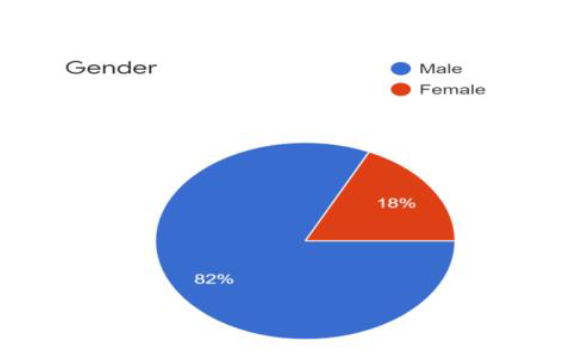
Demographic Profile:According to Figure 1 and Table 1 from the study, it was found that overall employees who responded to the questions were more male employees as compared to female employees, employed in the leading car sales unit.
Table 1: Gender
S. No
Options
Responses in %
1
Male
82
2
Female
18
-
Total
100
Table 2: Educational Qualification
Sl. No.
Educational Qualification
Responses in %
1
Graduation
67
2
Post-Graduation
33
-
Total
100
Table 3: Age of Respondents
Sl. No.
Age
Score in %
1
20 to 30 Years
50
2
31 to 40 Years
42
3
41 to 50 Years
6
4
Above 51 Years
2
TOTAL
100
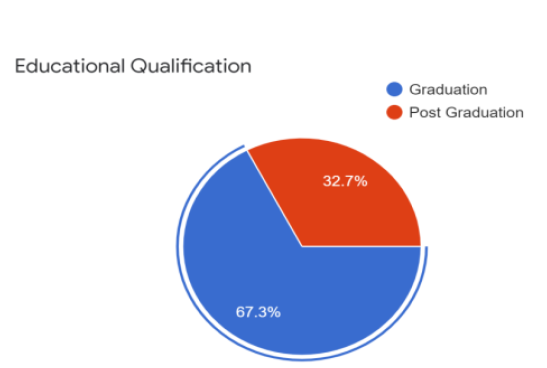
According to Figure 2 and Table 2 Most of the employees are postgraduates in the leading car sales unit, where others were graduates.
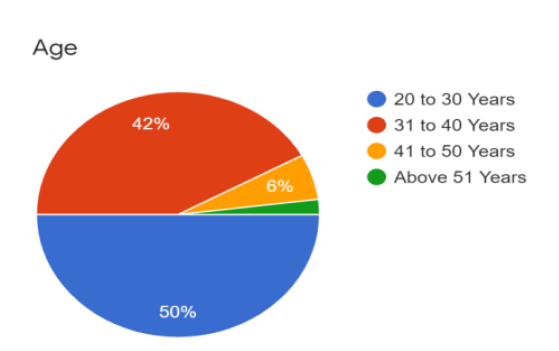
According to Figure 3 and Table 3 the respondents were mainly between the ages of 20 to 40 years and fewer responses were received from employees between the ages of 41 to 50 years.
Forms of Motivation
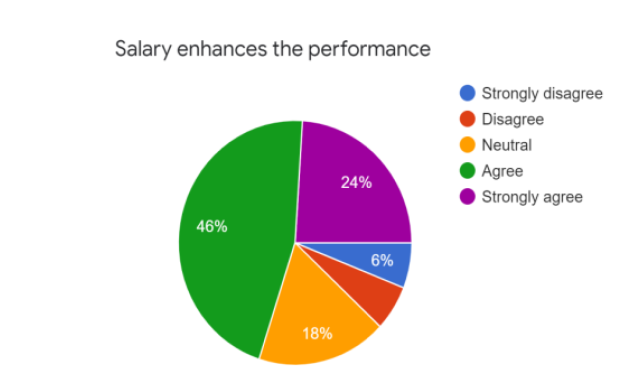
Drive to Acquire: According to Figure 4 the study found that 24 % of employees strongly agree that salaries improve the performance, while 46 % agree with the same and only 6 % strongly disagree.
Figure 3: Salary Enhances the Performance
Figure 4: Salary Enhances the Performance
Figure 5: Bonus, Perquisites and Incentives Increase the Performance
Figure 6: Mutual Reliance and Friendship among Co-Worker
Figure 7: Value the Collaboration and Team Work
Figure 8: Value the Collaboration and Team Work
Figure 9: Encourage Sharing Best Practices
Figure 10: Design the Job That Have Distinct and Important Role in the Organization
Figure 11: Designed the jobs that are meaningful and foster a sense of contributions to the organization
Figure 12: The Transparency of All Process (Assignment, Granting Rewards and Other Form of Recognition)
Figure 13: Fair Internal Management Procedure
According to Figure 5 28 % of employees were found to have strongly agreed response to the bonus, perquisites & rewards to increase performance, whereas 44 % agreed with the same and only 6 % disagreed with the same.
According to Figure 6 It was found that 26 % employees strongly agree with performance improves through appreciation whereas 42 % Agree with appreciation improves motivation performance of employees but only 6 % disagreed with the same.
Acquire to Bond
According to Figure 7, it has been found that 46 % of employees agree and 22% strongly agree that friendship between co-workers plays an important role in improving employee motivation and performance in their jobs.
According to Figure 8, it has been found that 52 % agree and 26 % strongly agree that teamwork and collaborationplays a vital role for employee motivation.
According to Figure 9 from the study, 46 % agree and 28 % strongly agree that sharing the employee's best practices increased motivation and enhances the productivity in their jobs.
Drive to Comprehend
According to Figure 10 50 % of employees have been found to believe that the work has been well planned and has a major role in the organization. It is also strongly agreed by 24% of employees.
According to Figure 11 54 % of employees have been found to agree and 20 % strongly agree that jobs are important and encourage a sense of contribution to the organization.
Drive to Defend
According to Figure 12 the study found that 57 % agreed on transparency of all processes and 20 % strongly agreed on transparency of management procedures
According to Figure 13, the study found that 46 % of employees agree that the organization has fair internal procedures and management practices, where 24% strongly agree with the same.
Findings
The study examined the relationship between motivational drives and the performance of employees and found that there is a positive relationship between the performance of employees and motivational drives. In the study it has been found that there were more male respondents who were between 20 to 40 years old. In drive to acquire, employees gave Agree responses that salary, bonus, perquisites, appreciation and incentives motivates them to enhance their performance, likewise in drive to bond employees were agreed that Collaboration, cooperation, friendship between co-workers are also motivates among employees to enhance the performance. Employees also agreed that jobs are well design, meaningful and foster a sense of contribution in drive to comprehend. In the drive to defend, respondents were also agreed that organization has fair internal management procedure and maintain a transparency. The overall process motivates the employees to enhance the performance in their job.
It is certain that the organization has preserved all its tools to motivate employees to remain engaged and achieve their desired objective. While 70 % of employees agreed that the organization provides the employee with all the equipments of motivation whereas 30 % of employees are still not satisfied with the actions taken by the organization to motivate employees.
CONCLUSION
The organization as a whole must take care of the four fundamental drives that are drive to acquire, drive to bond, drive to comprehend and drive to defend which accompanying improvement in employee performance and their overall source of motivation. It is also a major competitive advantage for organization in terms of employee engagement, employee satisfaction, commitment and reluctant to quit. Organizations are expected to take stock of what motivates their employees from time to time and revamp their reward policies. It is also vital for the organization to clearly identify the level of performance that is expected from the employees. Then relate compensation to performance which is an effective way to motivate employees.
REFERENCE
Brown, J. and B. Sheppard. Teacher Librarians in Learning Organizations. Paper presented at the Annual Conference of the International Association of School Librarianship, Canada, 1997.
Robbins, S.P. Organizational Behavior. 8th ed., Prentice Hall Sherman, 1998.
Chaudhary, N. and B. Sharma. “Impact of Employee Motivation on Performance (Productivity) Private Organization.” International Journal of Business Trends and Technology, vol. 2, 2012, pp. 29–35.
Katzenbach, J.R. and D.K. Smith. The Wisdom of Teams: Creating the High-Performance Organization. Harvard Business School, 1993.
Grant, A.M. “Employees without a Cause: The Motivational Effects of Prosocial Impact in Public Service.” International Public Management Journal, vol. 11, no. 1, 2008, pp. 48–66.
Kuvaas, B. and A. Dysvik. “Perceived Investment in Employee Development, Intrinsic Motivation and Work Performance.” Human Resource Management Journal, vol. 19, no. 3, 2009, pp. 217–236.
Irfansyah. “The Duties and Functions Performance of Aceh Human Resources Improvement Institutions in Scholarship Study Program Implementation in Aceh Government.” Britain International of Humanities and Social Sciences (BIoHS) Journal, 2020, pp. 160–165.
Ollukkaran, B.A. and R. Gunaseelan. “A Study on the Impact of Work Environment on Employee Performance.” Namex International Journal of Management Research, vol. 2, 2012, pp. 70–85.
Recommended Articles
Research Article
Analysis of the Influence of Leadership Style, Compensation Commitment and Work Stress on Performance (Case: Almarhamah Foundation Employee Padang Pariaman Regency)
Download PDF
Research Article
Marketing Agility: A Multi Layer Perspektif SME opportunities in Indonesia
Download PDF
Research Article
The Effect of Local Tax and Retribution on Direct Expenditure with Special Autonomy Fund as a Moderation In Districts / Cities of Aceh Province, Indonesia
Download PDF
Research Article
Consumer Behavior and the Effect of Covid-19 on Markets: An Empirical Study
Download PDF
PO Box 101, Nakuru
Kenya.
Email: office@iarconsortium.org
Editorial Office:
J.L Bhavan, Near Radison Blu Hotel,
Jalukbari, Guwahati-India


 Download PDF
 Download XML