Background: In spite of thorough preoperative assessment, unanticipated difficult airway poses a great challenge to the anesthesiologist for airway management in the perioperative period. Many airway adjuncts have been introduced into practice till date and has undergone rapid evolution but still, intubating stylets remain to be the” Gold standard “in managing such situations in majority of the medical centers in developing countries. Case Report: 42 year old female patient posted for elective laparoscopic cholecystectomy under general anesthesia with airway examination finding of 3 finger breadth mouth opening, Mallampatti grade 2 on preoperative assessment landed up in unanticipated difficult airway on operation table with Cormack lehane grade 4 laryngeal view. Even though, endotracheal intubation was performed using intubating stylet the possibility of breakage of stylet fragment was suspected and managed efficiently. Conclusion: Precautionary measures taken during our day to day anesthesia practice goes a long way in preventing iatrogenic or equipment related mishaps, thus emphasizing the importance of eternal vigilance for patient safety.
Keywords
Unanticipated Difficult Airway
Endotracheal Intubation
Airway Adjuncts
Intubating Stylets
Iatrogenic Foreign Body
Eternal Vigilance
INTRODUCTION
Endotracheal intubation remains as the “gold standard” in the intraoperative period for airway management to assist mechanical ventilation and ensure adequate oxygenation. However, failed or difficult endotracheal intubation remains a significant cause of morbidity and mortality [1] in spite of good preoperative airway assessment. Unanticipated difficult airway pose a great threat to the anesthesiologist and intubating a patient with an unanticipated difficult airway can be a challenging situation too. To combat this, many airway adjuncts have been introduced. Since its invention there has been a constant evolution to derive at the present devices. Intubating stylet is an essential airway adjunct used to facilitate endotracheal intubation. It is a malleable metal wire designed to make the endotracheal tube (ETT) conform better to the airway anatomy of an individual. There have been many modifications since its invention in order to improve the safety .In spite of all these measures ,we encountered a case of broken metallic stylet fragment in an endotracheal tube which was successfully managed without compromising patient safety.
Case Report
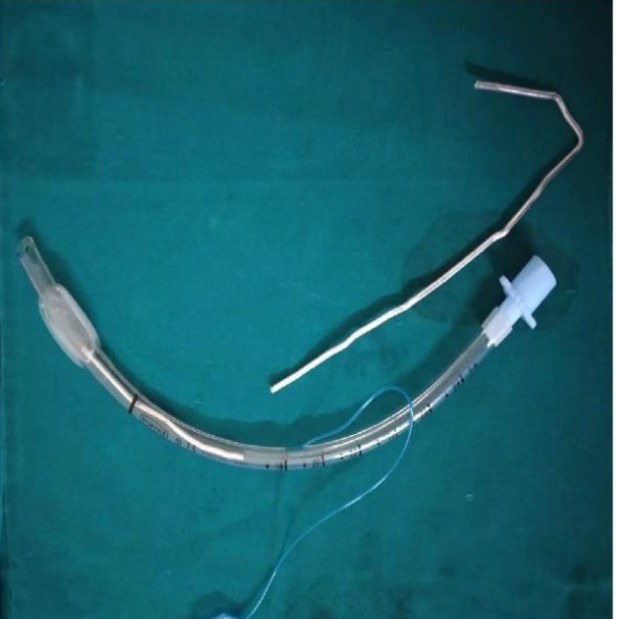
A 42 year old female patient diagnosed as chronic cholecystitis posted for elective laparoscopic cholecystectomy belonging to ASA classification 2 with BMI 28 kg/m2. Preoperatively, physical examination and investigations were within normal limits. Her airway examination revealed 3 finger breadth mouth opening, Mallampatti grade 2, thyromental distance 7 centimeter (cm), hyomental distance 6 cm, temper mandibular joint and neck movements were within normal range. Written informed consent was obtained. In the operation theatre, multipara monitors were connected and baseline values noted. Patient premeditated with 0.2 mg glycopyrrolate, 1 mg midazolam and 100mcg fentanyl administered intravenously. Induced with propofol 100 mg, muscle relaxant vecuronium 6mg administered intravenously to aid endotracheal intubation after confirming for adequate bag and mask ventilation.0n direct laryngoscopy using Macintosh blade size 3, we noticed Cormack lehane grade 4 laryngeal view. The first attempt of intubation with 7.5 mm internal diameter ETT aided by a metal stylet was performed. Immediately on removal of stylet the distal end appeared to be uneven and the difference in the length of the stylet appeared to be significant. The possibility and suspicion of broken stylet was made and endotracheal tube was removed immediately without attempting intermittent positive pressure ventilation. On examination, it was found that two fragments of the stylet which were broken from the main stylet were remaining in the distal part of ETT just proximal to the cuff as seen in figure 1. Bag and mask ventilation resumed, second attempt of laryngoscopy was done using Maccoy blade size 3 and endotracheal intubation was performed using a new stylet as bougie was not available in our institution. Bilateral air entry confirmed and surgical procedure started. Throughout the procedure, peak airway pressure and saturation was 18-20cm of water and 97-98% respectively. Surgical procedure lasted for 3 hours and it was uneventful. Patient was extubated and shifted to post-anesthetic recovery room. In post anesthetic care unit, serial chest X rays were done for double confirmation for the presence of any foreign body remnants and was found to be insignificant. The post-operative period remained uneventful and further follow up was normal.
Figure 1: Broken Fragments of the Stylet in the Endotracheal Tube
DISCUSSION
According to the American society of anesthesiologist practice guidelines for management of difficult airway intubating stylets result in successful intubation in 78- 100 % of difficult airway patients [2]. Reported complications from intubating stylet includes mild mucosal bleeding and sore throat [2-3] .There have been cases in the literature of breakage or shearing of the tip of the stylet which went unnoticed initially and later lead to serious complications [4-6] .
Intubation using an introducer or guide was first reported by Macintosh in 1949 [7]. In the initial stages, malleable metallic stylet made up of steel was introduced. With these devices there have been reports of broken metal piece of the stylet which remained unnoticed in endotracheal tube leading to it partial obstruction [8-9]. Hence, it was further modified to stylets with plastic coating on an aluminum guide. Even with these measures, there have been reports of shearing of plastic sheath covering the stylet [10-11].
Next step in the evolution is the invention of intubating fiber optic stylets with the intubation success rate of 96.8 – 100 % in difficult airways [2]. Newer options for management of anticipated difficult airway are the fiber optic bronchoscope, video laryngoscope and I-LMA. In developing countries due to cost constraints, non availability of high end devices and in unanticipated difficult airway situations the intubating stylets and bougie still remain as the “gold standard” airway adjunct devices. However, these devices are likely to have complications like breakage which can be prevented to a great extent if the following measures can be practiced routinely.
Metallic stylet are preferably for single use
Always inspect the stylet prior to and immediately after intubation
Preferable to use disposable plastic cover stylets
Stop advancing the ETT into the trachea once the tip of the ETT (not the tip of stylet) has just passed vocal cords, it is advisable to remove the stylet at this stage and advance the ETT further
Care should be taken to avoid applying excessive force or blindly advancing the stylet into the trachea during introduction of ETT and also during removal of stylet from ETT
Stylet tip should be preferably above murphy’s eye of ETT
Use safety end caps to prevent migration of the stylet during intubation
Use of water soluble lubrication on the stylet before loading endotracheal tube
It is preferable to have a bend angle of the stylet that should not exceed 35 degrees which enhances the ease of tracheal tube insertion and minimizes the resistance encountered during removal of the stylet [12]
In our case, the breakage of the stylet could have occurred due to repeated use of same stylet and excessive angulation applied to navigate through the vocal cord even though excessive pressure during insertion and removable of the stylet was not carried out. Thorough vigilance of the stylet which was done by us prior to and immediately after intubation guarded us from causing iatrogenic foreign body which could have led to catastrophic complications if it was left unnoticed. Following these preemptive measures routinely, goes a long way in preventing mishaps occurring due to these equipments and ensures patient safety.
REFERENCE
Benumof J.L. "Management of the difficult adult airway with special emphasis on awake tracheal intubation." Anesthesiology, vol. 75, no. 6, 1991, pp. 1087–1110.
Apfelbaum J.L. et al. "Practice guidelines for management of the difficult airway: an updated report by the American Society of Anesthesiologists Task Force on Management of the Difficult Airway." Anesthesiology, vol. 118, no. 2, 2013, pp. 251–270.
MacQuarrie K. et al. "Tracheal intubation using Bullard laryngoscope for patients with a simulated difficult airway." Canadian Journal of Anesthesia, vol. 46, no. 8, 1999, pp. 760–765.
Fathi M., Farzanegan B. et al. "A piece of broken metal from intubation stylet retained in tracheobronchial tree: a case report." Tanaffos, vol. 13, no. 4, 2014, pp. 51–54.
Barde S., Roy P.M. et al. "Unusual airway foreign body: vigilance is the price of safety." Journal of Anaesthesiology Clinical Pharmacology, vol. 31, no. 4, 2015, pp. 568–569.
Karamustafaoglu Y.A., Yanik F. et al. "A rare cause of cough: an unnoticed broken metallic stylet in trachea." Indian Journal of Thoracic and Cardiovascular Surgery, vol. 28, no. 4, 2012, pp. 270–271.
Hung O.R. and Stewart D.D. "Intubating stylets." Benumof and Hagberg’s Airway Management. 3rd ed., Philadelphia: Elsevier Saunders, 2013, pp. 430–442.
Rabb MF. et al. "An unusual cause of partial ETT obstruction." Anesthesiology, vol. 88, no. 2, 1998, pp. 548.
Zmyslowski WP et al. "An unusual cause of endotracheal tube obstruction." Anesthesiology, vol. 70, no. 5, 1989, pp. 883.
Sharma A. et al. "A rare cause of endotracheal tube obstruction: a broken stylet going unnoticed—a case report." Middle East Journal of Anesthesiology, vol. 19, no. 4, 2008, pp. 909–911.
Shetty S. et al. "A sheared stylet." BMJ Case Reports, 2010, bcr0220102725.
Levitan R.M., Pisatura J.T. et al. "A stylet bend angles and tracheal tube passage using a straight-to-cuff shape." Academic Emergency Medicine, vol. 13, 2006, pp. 1255–1258.
Recommended Articles
Research Article
Comparison between Ultrasound Guided Thoracic Paravertebral Block and Intercostal Nerve Blocks for Pain Relief Following Multiple Rib Fractures
Nadia T. Al-Bayaty,
Amar Salti
Published: 30/03/2026
Download PDF
Research Article
Evidence Guided, Experience Based and Patient Compatible 3-Step Protocol for Managing Moderate to Severe Category of COVID19 Infections
Farah Husain,
...
Kirti N Saxena
Published: 05/01/2021
Download PDF
Research Article
A Descriptive Cross-Sectional Study to Evaluate the Knowledge about Symptoms and Risk Factors for Heart Attack (Myocardial Infarction) Among the General Population of New Delhi
Aastha Sehgal,
...
Avneet Kaur
Published: 06/05/2023
Download PDF
Research Article
Knowledge About Risk and Preventive Factors for Osteoarthritis Knee among Ortho OPD Patients in Regional Hospital, Keylong in District Lahaul and Spiti of Himachal Pradesh
Ajay Thakur,
Jaspal Chaudhary
Published: 20/06/2022
Download PDF
PO Box 101, Nakuru
Kenya.
Email: office@iarconsortium.org
Editorial Office:
J.L Bhavan, Near Radison Blu Hotel,
Jalukbari, Guwahati-India
Renuka, R. & Mounashree, B. (2020). Role of preemptive measures in prevention of anesthesia mishaps. IAR Journal of Anaesthesiology and Critical Care, 1(1), 1-3.
MLA
Renuka, R. and B.R. Mounashree. "Role of preemptive measures in prevention of anesthesia mishaps." IAR Journal of Anaesthesiology and Critical Care 1.1 (2020): 1-3.
Chicago
Renuka, R. and B.R. Mounashree. "Role of preemptive measures in prevention of anesthesia mishaps." IAR Journal of Anaesthesiology and Critical Care 1, no. 1 (2020): 1-3.
Harvard
Renuka, R. and Mounashree, B. (2020) 'Role of preemptive measures in prevention of anesthesia mishaps' IAR Journal of Anaesthesiology and Critical Care 1(1), pp. 1-3.
Vancouver
Renuka R, Mounashree B. Role of preemptive measures in prevention of anesthesia mishaps. IAR Journal of Anaesthesiology and Critical Care. 2020 Jul;1(1):1-3.


 Download PDF
 Download XML